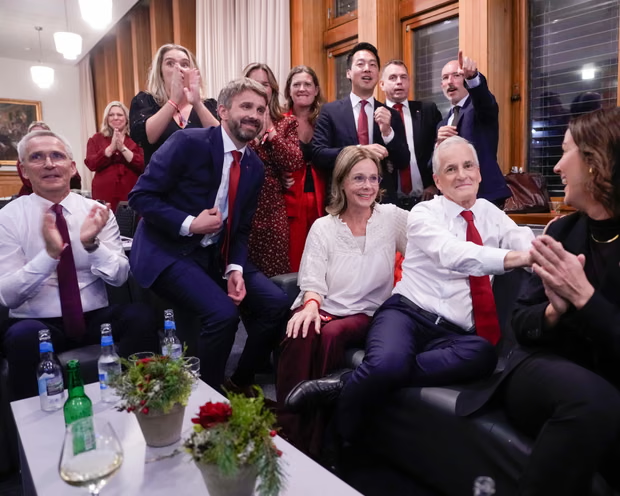
Norway’s Labour party has won re-election, securing four more years in government despite a strong surge for the populist right. The centre-left party, led by Prime Minister Jonas Gahr Støre, was projected to win 89 seats, while the centre-right bloc took 80 seats. A majority in parliament requires at least 85 seats.
With nearly all votes counted, the results confirmed Labour as the largest party. The election saw unusual polarisation, with debates focused on the cost of living, wealth taxes, oil fund investments in Israel, and Norway’s relationship with former U.S. President Donald Trump.
The right-wing Progress party made significant gains, reportedly doubling its size in parliament over the last four years. Support was particularly strong among young men, a trend some analysts have described as the “Maga-fication” of Norwegian politics. There was speculation that Progress party leader Sylvi Listhaug could have become prime minister if the right-wing bloc had won.
The Conservative party had its worst election performance in two decades. Party leader Erna Solberg confirmed the defeat, saying the Conservatives will now serve as an opposition party. Solberg, 64, also acknowledged personal responsibility for the loss amid calls for her resignation.
Prime Minister Støre welcomed the results, highlighting that social democracy can win even amid a right-wing wave. Speaking to supporters, he said the outcome sends a strong message that Norway continues to support centre-left policies.
Labour’s victory comes after a challenging campaign. Early criticism focused on the government’s handling of the Norwegian oil fund’s investment in Israel. Analysts expect Støre to engage in careful negotiations with smaller left-wing parties to ensure stable governance.
Gaute Børstad Skjervø, leader of Labour’s youth wing, described the outcome as “the comeback of the ages in Norwegian politics.” He added that just a year ago, Labour seemed “doomed,” making this re-election a major turnaround.
Despite the Progress party’s rise, Labour’s victory positions Norway as an outlier in the Nordic region. Unlike Sweden and Finland, both now led by right-wing governments, Norway will continue under a centre-left administration.
Støre, 65, who has served as prime minister since 2021, is expected to remain in office with support from Jens Stoltenberg, the former NATO secretary-general, who is likely to take on the role of finance minister. The alliance is expected to strengthen Labour’s position and help guide the country through ongoing economic and geopolitical challenges.
Sylvi Listhaug, 47, leader of the Progress party, called Støre to congratulate him on the victory. She expressed satisfaction over her party’s improved performance compared to polls and said there is still reason for optimism despite not achieving a majority.
The election saw high voter engagement, with a record 1.9 million people taking part in early voting. Most early votes were counted before polls closed, contributing to the swift confirmation of the results.
Analysts say the vote shows a divided Norway. While the centre-left remains in power, the rise of populist forces signals growing tension in the country’s political landscape. Economic issues, particularly wealth inequality and rising living costs, played a key role in shaping voter preferences.
The Labour party’s victory reinforces Norway’s commitment to social democracy, even as neighbouring countries shift to the right. Observers expect Støre to prioritize domestic stability, strengthen social programs, and manage the oil fund carefully while balancing international relations.